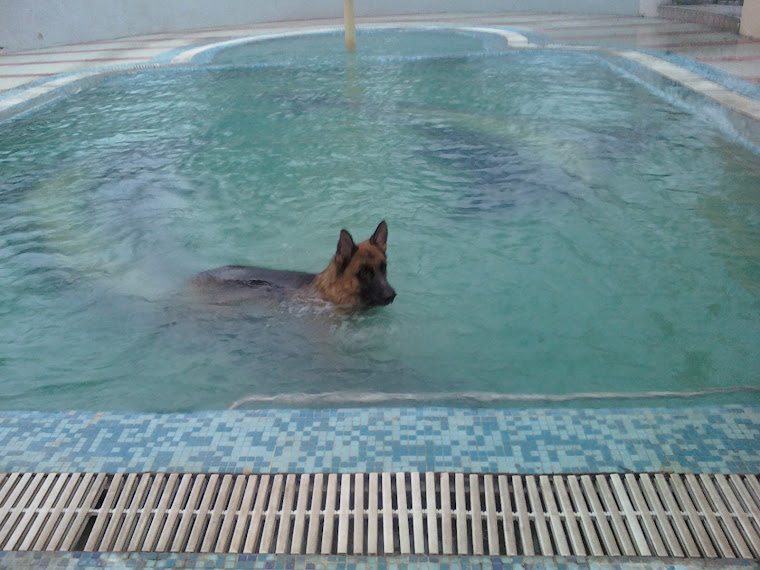
CALVIN

CALVIN
CALVIN - THE KING

Monday, 12 July 2010

The Bark: What is Your Dog Saying?

A few years ago, an article in the Smithsonian magazine concluded that dogs may bark for no reason. It's just something that they do – a function without a purpose, so to speak. That view is not widely shared. Even dry, dusty studies of wild canine behavior attest to the fact that barking serves a function of long-range communication. It is at least as important to dogs as a marine foghorn warning is to mariners. Even the most elementary interpretation of barking is that it is a non-visual communication signaling the dog's presence and territorial concerns.On hearing a bark, the receiver of this audible message knows:
The presence of another dog out there
His approximate direction
His approximate distance
The sender's level of the excitement/energy/commitmentThe sender of the message knows exactly what he is transmitting but may not know to whom.
If the recipient responds by barking back, he confirms:
The receipt of the message
His presence of another dog out there
His location and energy level (by how hard and fast he barks)All of the above is really "old hat" and well accepted. What becomes more controversial, however, is whether the bark is more than just a "here I am" type noise that signals a dog's location and territorial claim. Most dog owners believe that they can recognize their dog's different types of barking. The dog may, for example, emit an excited, alerting bark when a friend approaches the home but may sound more aggressive and foreboding when a stranger or a would-be intruder draws close. In addition to the different tones of barking, the same tone of bark can be used in different situations to "mean" different things.If your dog's ball has rolled under the couch and he wants someone to get it out, he may bark for assistance. A learned communication, like verbal language in people, a bark is used in this context because it works to produce the desired response from you. Once he gains your attention, you recognize immediately what the dog wants by: the barking itself, the dog's orientation, and the situation. Humans also use a variety of signals to communicate with each other; they speak, orientate, gesticulate, and use facial expressions and other body language.But could you understand what your dog wants by listening to it bark on the telephone? Probably not. But you might be able to determine the tone of the bark (friendly or hostile), the volume and intensity of the bark (his state of arousal) and the duration of barking – continuous or intermittent (indicating how intent the dog is). Obviously, barking is not as sophisticated a method of vocal communication as human language but it works to convey elementary messages. Humans probably grunted their wishes to each other and barked orders a few hundred generations ago. It was a start. Interestingly, human consonant sounds are thought to be "hard-wired" from these humble beginnings just as the dogs bark is "hard-wired." Human language (in any country) comprises different constellations of consonants strung together in creative ways. Dogs have a long way to go to catch up but some do seem to try very hard with what little hard-wired sound-producing ability they possess by using different intensities, tones, and groupings of barks, growls, and mutters, interspersed with the occasional howl to get their message across.Their sophisticated body language compensates to some extent for this limited vocal response. With patience, dogs can "train" their human counterparts to understand what they're trying to say.

Dog to Dog Communication

Without a sound, two properly socialized dogs meeting for the first time can size each other up in just a few moments. An exchange of glances can tell each canine if they're going to be friends or enemies.How can dogs do this without a sophisticated verbal language? The answer: facial expressions, body language and posturing. Although dogs signal intent by barks and growls, the message is not complete without the telegraphy of body and facial language.Various parts of the dog's body are involved in this form of communication. Here is a quick primer in canine body language.Facial Expressions A combination of facial expressions communicate a dog's mood and intentions that can be understood by other species, including humans. Here are a few examples of facial communication:
Relaxed mood: Soft eyes, lit up, looking – but not staring. Ears forward or flopped, with tips bent over (if anatomically possible).
Mouth open, lips slightly back, giving the impression of smiling. Tongue hanging limply from the side of the mouth
Anxiety: Eyes glancing sideways or away. Ears to the side of the head or flopped. Teeth clenched, lips firmly retracted. Tongue either not evident or lip licking
Intimidating: Eyes staring like searchlights. Ears forward. Teeth bared
Fearfulness: Eyes looking forward or away, pupils dilated. Ears pressed back close to the head. Panting/breathing hard through clenched or slightly open mouth. Jaw tense so that sinews show in the cheeks
Stress: Yawning plus other signs of anxiety or fearfulness (as above)Head-Neck Position
Head down ("hang dog"): Submission or depression
Head in normal mid-way position: Everything is all right
Head/neck turned to side: Deference
Head held high/neck craning forward: Interest or, depending on other signs, a challenge
Head resting on other dog's back: Demonstrating dominanceTorso/Trunk/Upper Limb
Tensing of muscles and the raising of hackles: Threat/imminent fightGestures
Play bow – head low, rump elevated: The universal sign of canine happiness and an invitation to play
Paws on top of another dog's back: Dominance
Looming over: Dominance
Rolling over: Submission/deference
Urinating by squatting: Deference
Urinating by leg lifting: Dominance/defiance
Humping: Dominance
Backing: Unsure/fearfulTail Position
Tail up: Alert, confident, dominant
Tail wagging: Dog's energy level is elevated (excited or agitated)
Tail held low or tucked: Fearful, submissive
Tail held horizontal and wagging slowly: Caution
Tail held relaxed and stationary: Contented dogThere is no one sign that gives away a dog's feelings but if you consider all the body language signs, you can get a pretty good idea of what's going on in the dog's head. A dog that is staring at another dog, his ears pricked and his tail stiff, is probably conveying dominance, or at least a wish for it.A dog that averts his gaze from another dog and hunkers down nervously as if waiting for an explosion is likely fearful and is trying to defuse the situation by acting submissive. Sometimes body language signs can be ambivalent, however. For example, it is not uncommon to observe a dog growling at another dog while occasionally glancing to the side, backing up, and with his tail wagging. Such a dog is invariably fearful. Whenever fear signs are present, fear is in the equation. These dogs are unpredictable with other dogs and will alter their body language and behavior according to circumstances. If the opposing dog retires, they may jump around and "look happy." If the opposing dog approaches too close the fearful one may snap or bite. Owners, if present, can help defuse their dog's ambivalence and uncertainty by taking a strong leadership role. It's amazing how rapidly a fearful dog's disposition will change when an authoritative owner steps in and controls the moment. Dogs need strong leaders. Another aspect of communication is odor. Because dogs have such an amazing sense of smell, it is likely that they learn a lot about other dogs from their smell. That's what all the sniffing is about. It is difficult to imagine what sort of information passes between dogs via this medium. We do know that intact male dogs "smell male" (because of male sex pheromones) and that neutered males do not have this characteristic musk. By neutering males, we alter the olfactory signals they emit and thus other dog's perception of them. It may even be that the "non-male smell" equates with a diestrus (in-between heat periods) or a neutered bitch smell.When an intact male dog meets a neutered one, the response may not be confrontational because the other dog doesn't perceive a rival. He may believe the neutered dog is female.Non-verbal communications signaling "let's play," "leave me alone," "who do you think you're talking to," "I'm not going to cause you a problem, I promise," are going on all the time between dogs but many dog owners don't realize it. It's amazing what can be conveyed with the odd glance or posture. Some dogs are masters at such subtle language.The worst canine communicators are those dogs that have been raised without the company of other dogs during a critical inter-dog socialization phase of their lives (3 to 6 weeks). Hand raised orphans provide an extreme example of what may be lacking. Many of these dogs are socially inappropriate having not learned canine communication and social etiquette. They may attack and continue to attack another dog when the psychological war is already won. They may not know how to signal defeat when they are being attacked themselves. And that's just the (extreme) tip of their communication failures.Most dogs are not this "dyslexic" and can communicate what they need – as with humans – but the good communicators usually have the edge. Fully functional body language is a beautiful thing that can help resolve uncertainties at a glance. Humans communicate in body language too. We're just not so good at it and some of us are positively stiff. If dogs could talk they'd probably categorize us as "dumb animals."
Thursday, 10 June 2010

TODAYS UPDATE (10.6.10)

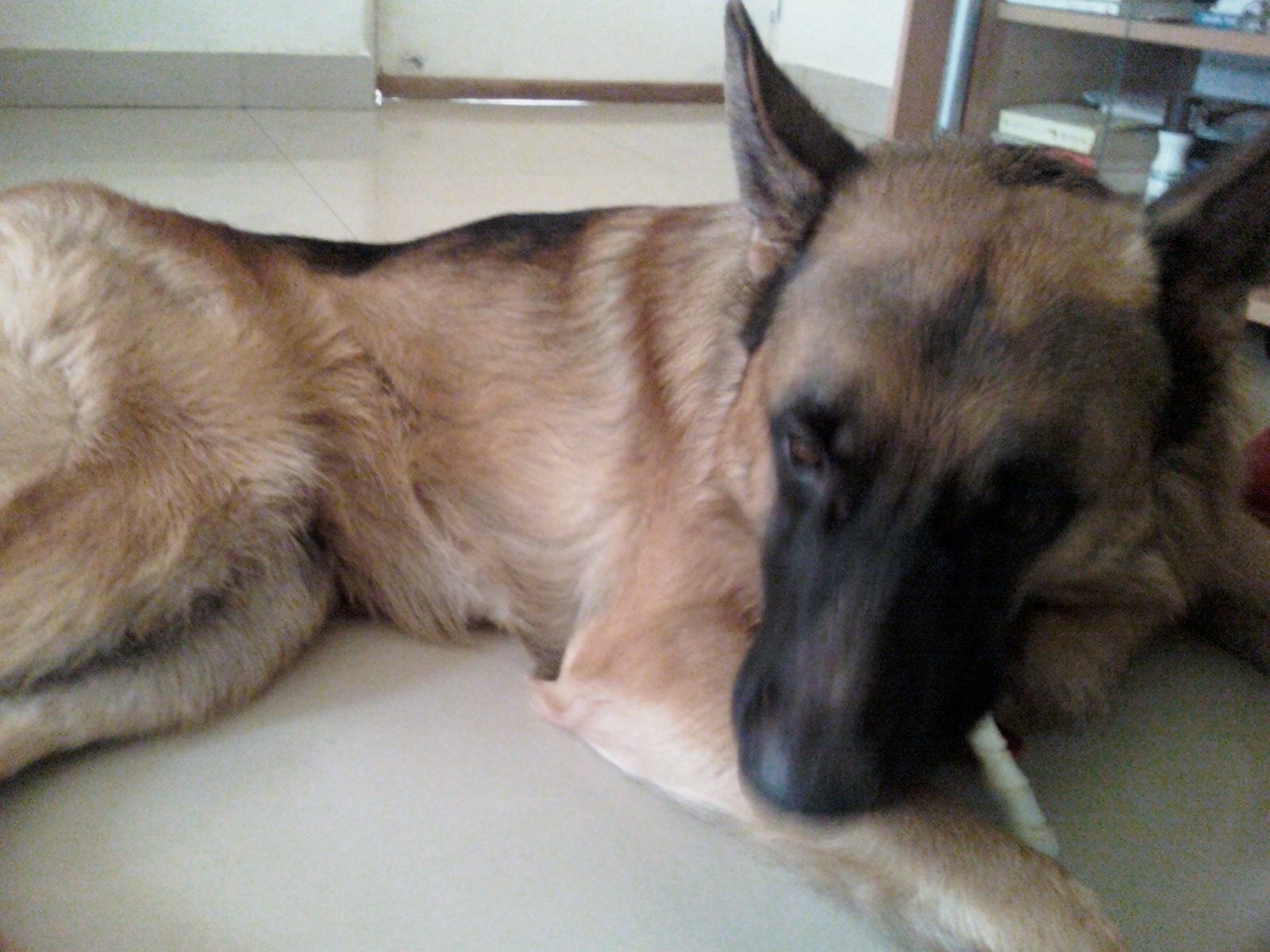
THIS IS MY BED..... REST OF YOU CAN FIND A SPOT FOR YOURSELF :-P

STEALING MUMMY'S PLACE ....HEHEHE...... SHE DOESN'T MIND ;-)


Monday, 7 June 2010

TODAY'S UPDATE (7.6.2010)

AFTER THE RAIN DANCE :-DDANCING IN THE RAIN

I LIKE IT

MY DEN


CALVIN'S DEN

LUNCH....HEHEHE........JUST FINE TUNING MY LAZINESS

Sunday, 17 January 2010

Spicy Rajma

Many common types of beans are served in my kitchen in one form or another. Beans are highly versatile foods and can easily be served as a side dish, appetizer, main dish and even a dessert. Given that we’re in the middle of winter, I like to return to my comfort foods, which includes hearty dark red kidney bean stew. Nothing is more satisfying to me than a big bowl of hot rajma on a blustery winter day. However you define them – legumes, dried beans, pulses or dals (in my nani’s kitchen) – they are an essential and nutritious part of many ethnic cuisines around the world.

Today I wanted to share a simple recipe using dried red kidney beans which can be prepared with any combination of roots or your choice of vegetables and spices. Bean dishes are generally served with chapati, nan, or simply over plain boiled rice (my preference!). Spicy red kidney beans or rajma (really Indian version of chili without meat) is a one of my childhood comfort foods and remains so to this day. Enjoy!

1/2 pound dried red kidney beans, soaked overnight
2 tablespoons vegetable oil
1 large onion, finely chopped
1 1/2 tablespoons ginger-garlic paste
1/4 teaspoon turmeric and salt to taste
1/2 tablespoon ground coriander-cumin
1 teaspoon mild chili powder or to taste
1/2 Teaspoon Kasoori Methi
2 medium tomatoes, chopped or canned crushed tomatoes
1 teaspoon garam masala – optional
Coriander leaves for garnishing

1) Wash and drain the red kidney beans thoroughly. Place beans in a heavy-bottomed 3-quart saucepan and add 3 to 3 1/2 cups water. Bring to a full boil over high heat and skim off any foam that rises to the top. At this stage I like to add 1 teaspoon salt, 2 large crushed garlic cloves, 1-inch crushed ginger slice, 1 bay leaf, 1 2-inch cinnamon stick and 1 teaspoon oil. Cover partially with a tight-fitting lid and reduce the heat to medium. Simmer beans for approximately 50 to 55 minutes or until kidney beans are fork tender. Or if you like to use drained canned red kidney beans omit the step # 1 and simply follow the step # 2 except use a larger saucepan rather than a skillet.
2) Meanwhile in a large skillet, heat 1 tablespoon oil and sauté the onion until lightly brown. Add the remaining ingredients except garam masala and coriander leaves. Cover and cook for approximately 8 to 10 minutes or until tomatoes are softened. Cool the onion-tomato mixture and puree until smooth. I omit this step.
3) Add the onion-tomato puree and garam masala to simmering beans and mix thoroughly. Cover; turn heat to very, very low and cook for 15 to 20 minutes. Remove the crushed garlic, ginger, bay leaf and cinnamon stick. At this stage mash about 1/8 cup of beans to make the bean dish thicker if needed. Again I omit this step. Adjust the consistency of the dish by adding more liquid as needed. Taste and add extra seasonings. Remove the whole spices and discard. Before serving allow beans to rest for at least 30 minutes so that the flavors have a chance to blend. Serve the spicy red kidney beans garnished with freshly chopped coriander leaves and lemon wedges on the side.
Yield: approximately 6-8 servings

Note: Most bean dishes are best tasting if prepared in advance and some varieties freeze quite well. Traditionally ghee (clarified butter) was used in this dish and asafetida (and a bunch of whole spices – cumin seeds, whole black peppercorns, red chili and black cardamom pods and acidic ingredients – cider vinegar, dried mango powder or tamarind etc.) is a must-have seasoning. Depending upon the consistency of the dish use about 1 teaspoon flour while sautéing the onion. When it comes to these dishes there are as many variations as there are cooks. My favorite bean dishes (whole beans – kidney beans, soybeans, chickpeas or whole urad) are always cooked in the pressure cooker.

CALVIN'S 1ST B'DAY